Mykola GnatovskyyThe European Court of Human Rights and the European Committee for the Prevention of Torture and Inhuman or Degrading Treatment or Punishment: Praestat Cautela Quam Medela
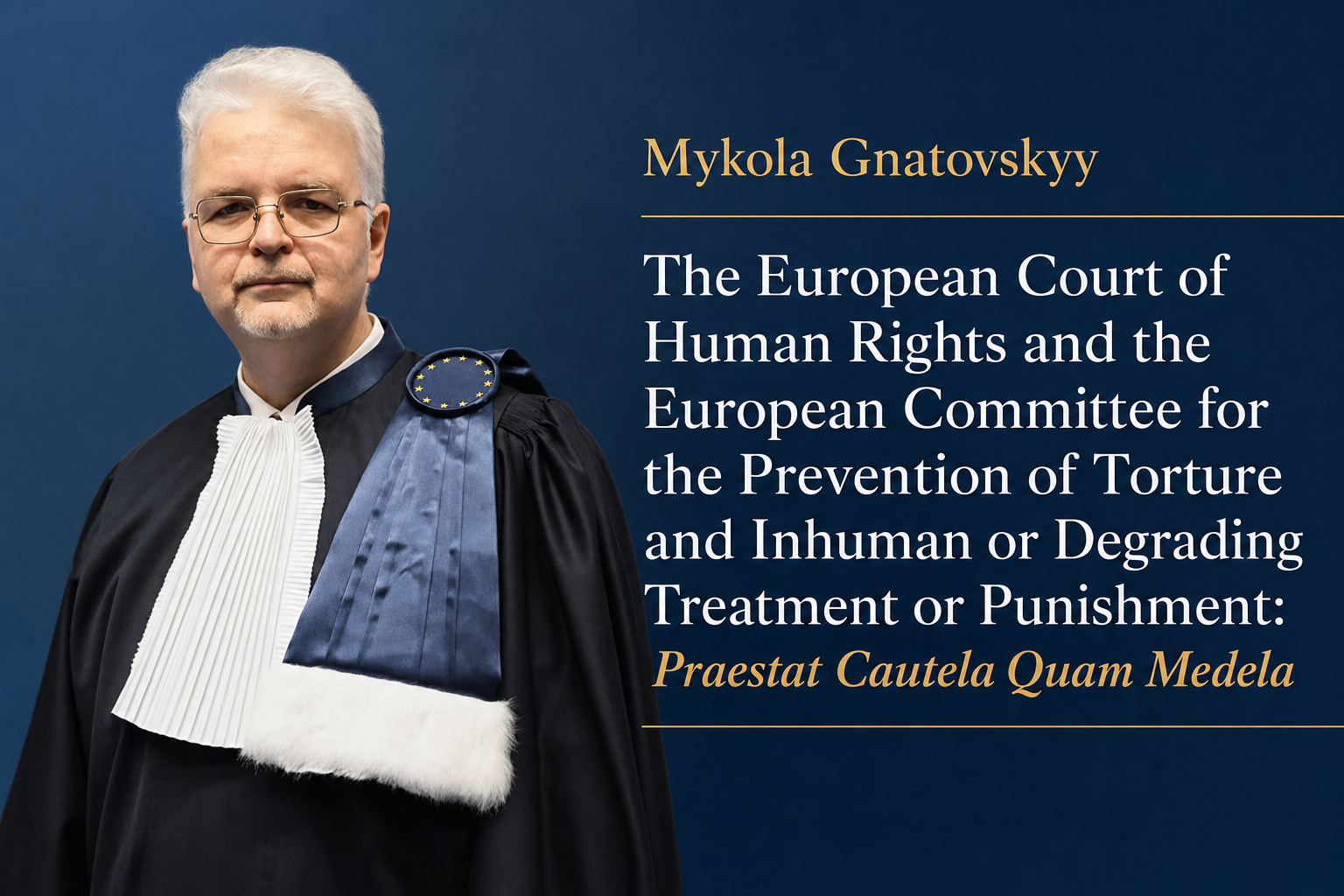
Вашій увазі пропонується стаття вченого та практика — судді Європейського суду з прав людини від України, колишнього Президента Європейського комітету із запобігання катуванням Миколи Гнатовського. Унікальність цієї публікації — у поєднанні двох перспектив, які рідко доступні одній людині: понад десять років роботи в Комітеті, включно з посадою його Президента, та нинішня суддівська діяльність у Страсбурзькому суді. Спираючись на цей рідкісний досвід, пан Микола Гнатовський глибоко й водночас доступно розкриває діалектику взаємодії превентивного (ЄКЗК) та судового (ЄСПЛ) механізмів захисту від катувань, слушно резюмуючи її латинським афоризмом praestat cautela quam medela — «застереження краще за лікування». Це текст, який варто прочитати кожному, хто цікавиться архітектурою європейської системи захисту прав людини зсередини — очима людини, яка сама брала участь у формуванні обох елементи.
There is a venerable maxim to the effect that precaution is preferable to cure: praestat cautela quam medela. 1 Few arrangements within the European system for the protection of human rights illustrate that wisdom as faithfully as the relationship between the two Strasbourg institutions charged, in their different ways, with the eradication of torture and other forms of ill-treatment: the European Court of Human Rights (the Court) and the European Committee for the Prevention of Torture and Inhuman or Degrading Treatment or Punishment (CPT or the Committee), known to all who work in this field simply as the CPT. The one furnishes the cure: the authoritative judicial finding that a state has breached its obligations, with all the remedial consequences that follow. The other furnishes the precaution: the confidential and recurrent scrutiny of the places where human beings are held against their will, undertaken precisely so that the Court should, ideally, never be called upon to pronounce at all.
I write about this relationship with a certain duality of perspective. For more than a decade I served on the Committee, latterly as its President; I now sit on the Court. Moving from one to the other, one comes to appreciate that the two are not merely complementary in the abstract but bound together in a way at once intimate and, on occasion, productively uneasy. It is that interrelationship, its underlying logic, its many points of contact, and the misunderstandings to which it can give rise, that I should like to reflect upon here, conscious that the views expressed are mine alone.
The Committee owes its existence to an insight that is also a confession of the limits of adjudication. The drafters of the 1987 European Convention for the Prevention of Torture 2 (ECPT or the 1987 Convention) proceeded from the premise that the judicial machinery established under the 1950 Convention, the European Convention on Human Rights (ECHR or the Convention), for all that it had achieved, addresses violations after the fact, once a victim has already suffered, complained, and exhausted the available domestic remedies. The explanatory report to the 1987 Convention puts the matter in clear terms: the existing system, founded on complaints by individuals or by states, could usefully be supplemented by a non-judicial machinery of a preventive character, whose task would be to examine the treatment of detained persons with a view to strengthening their protection. 3 The 1987 Convention accordingly created a Committee empowered to visit any place within a party’s jurisdiction where persons are deprived of their liberty by a public authority. Prevention, not condemnation, was to be its purpose, and cooperation, not contradiction, its method.
The intellectual origins of the enterprise lay outside the courts of law altogether. The idea of independent, unannounced monitoring visits to all places of detention as a means of forestalling torture is owed in large part to the Swiss philanthropist Jean-Jacques Gautier, who grasped that torture corrodes not only its immediate victims but the very societies that tolerate it. 4 Transposed into the Council of Europe, an organisation founded not to stay neutral, like the International Committee of the Red Cross, but to defend a particular set of values, the insight produced a body at once intrusive and cooperative. The Committee’s working principle is confidentiality, and its preferred method is dialogue rather than denunciation. That ethos shapes what the Committee learns, how candidly states engage with it, and, ultimately, what reaches the Court. The very discretion that admits a delegation to the hidden corners of a state’s detention estate makes the Committee’s knowledge so valuable, and so different in kind from anything an adversarial procedure could yield.
On many occasions the Committee has been described as the Court’s eyes and ears. The metaphor is apt, but it can mislead if pressed too hard. It is literally true on those occasions, rare and largely fortuitous, when a published CPT report happens to concern the very establishment and period that is in issue before the Court. Even then the information gathered by the Committee during the visit but not included in the published report would forever remain secret from everyone, including the Court. Far more often the Committee’s contribution is of a different and more diffuse order. It supplies the Court not with a snapshot of one cell on one day but with the accumulated, comparative, empirically grounded understanding of detention across the continent that no applicant or Government could ever assemble.
Here a distinction must be drawn that is too frequently elided. The CPT is a monitoring body; it is not, strictly speaking, a standard-setting one. Within the Council of Europe, the elaboration of standards is principally the province of the Committee of Ministers, whose recommendations, the European Prison Rules 5 foremost among them, constitute the formal soft-law architecture of the field. The Committee’s task is to observe, to assess, and to recommend, measuring the reality it encounters against requirements whose normative authority derives from elsewhere.
And yet monitoring cannot be conducted in a vacuum, for any assessment must be made against something. The text of Article 3 of the ECHR is as famously succinct as it is categorical; and while the Court’s case law has built a wealth of useful concepts around it, that body of jurisprudence, taken alone, would be wholly insufficient to yield the detailed and constructive advice that the authorities of a visited state require. Over more than three decades of visits the Committee has therefore amassed so substantial a body of comparative material and practical experience that it has, almost of necessity, developed standards of its own. This owes much to the Committee’s multidisciplinary composition. Lawyers of varied backgrounds and specialisations have historically been its most numerous members, but they have always worked alongside other professionals – doctors versed in prison healthcare, psychiatrists, forensic specialists, and people who have themselves run places of detention. Each has enriched the Committee with expertise that the law alone could not supply. That balance is itself a safeguard: so long as the Court’s case law and the recommendations of the Committee of Ministers remain the backbone of its work, the breadth of the Committee’s membership guards against the danger that the bias of any single profession, or any particular research agenda, might weigh disproportionately upon the standards it develops.
Those standards are valuable, but they are also frequently misunderstood. They are not, and were never intended to be, mechanical thresholds for the establishment of a violation of Article 3 of the Convention. That provision enshrines an absolute prohibition, one of the most fundamental values of a democratic society, and admits no derogation whatsoever. 6 The point is best illustrated by the vexed question of living space in prisons, perhaps the single matter on which the two bodies’ approaches have been most closely scrutinised. Since the 1990s the Committee has advocated a minimum of four square metres of living space per prisoner in multi-occupancy cells. When the Grand Chamber came to address the issue in Muršić v Croatia, 7 some anticipated a collision: would the Court simply adopt the Committee’s figure as the dividing line between the lawful and the unlawful? It did not, and, in my strong conviction, it was right not to. The Court held that a strong presumption of a violation arises where a detainee disposes of less than three square metres of personal space, and that space in the range of three to four square metres remains a weighty factor to be assessed together with the other conditions of detention. The four-square-metre figure was thus neither enthroned as a rule nor dismissed as irrelevant; it was integrated, with the Court expressly affirming its attentiveness to the Committee’s standards and to the contracting states’ observance of them. In practice the Court has found, in a great many cases, that Article 3 was violated where the living space available to a prisoner fell below four but remained above three square metres, the violation arising not from the shortfall in space alone but from its combination with other aggravating factors. This is precisely what the CPT has warned of, time and again: overcrowding is never merely a question of insufficient space; it sets in motion a train of related deficiencies, in regime, hygiene, ventilation, and the relations between prisoners and staff alike.
The lesson of Muršić is a general one. The Committee’s standards describe what is desirable and identify what is unacceptable; the Court’s threshold for finding any breach of Article 3 is, by its nature, a high one. To treat every shortfall from a CPT standard as in itself an Article 3 violation would be to confuse prevention with adjudication – to demand that the Court do the Committee’s work, and the Committee the Court’s. That the two scales do not coincide is not a contradiction between the bodies but the very design of the system. The Committee deliberately sets its sights high, so that practice should never approach the floor below which the Court must intervene.
The interrelationship is rendered more intricate still by the way the Committee’s mandate is delimited. On the one hand, it is bounded by the concept of deprivation of liberty, and here the Committee takes its bearings from the Court, which alone gives autonomous meaning to that notion under Article 5 of the ECHR. On the other hand, its substantive preoccupation is the prevention of treatment contrary to Article 3. Yet such treatment seldom stands apart from the Convention’s other guarantees; very often it grows out of disrespect for rights protected elsewhere, so that an issue the Committee approaches under the heading of ill-treatment turns out, from the Court’s perspective, to implicate several provisions at once.
The detention of persons with mental disorders is the clearest example. The logic of Rooman v Belgium, 8 that the lawfulness of such detention under Article 5 ECHR is bound up with the actual provision of appropriate therapeutic treatment, shows how a deficiency that might at first appear to belong to one provision shades into the territory of another. A psychiatric establishment that fails to treat does more than detain unlawfully; in its gravest forms failure to treat may amount to inhuman or degrading treatment. The Committee, approaching the same reality from the standpoint of prevention, has long denounced the phenomenon of therapeutic abandonment and the absence of legal safeguards surrounding involuntary placement and treatment. What the Committee frames as a risk of ill-treatment under Article 3 ECHR, the Court may ultimately analyse under Article 5, under Article 8, or under Article 3 itself, according to the facts before it. Such analysis may also involve not only negative but also positive obligations of the state, including the procedural ones.
This last point repays a moment’s attention, for it explains a divergence that is sometimes mistaken for inconsistency. On the same set of facts the Court may conclude that the threshold of seriousness has been reached for the purposes of Article 8 ECHR (the right to respect for private life, including physical and psychological integrity) but not for the higher threshold of Article 3; 9 and where it does find a violation of Article 3, it commonly sees no need to examine separately whether the same conduct also breached Article 8. The Committee’s recommendations, framed throughout in the idiom of Article 3 prevention, frequently bear upon this Article 8 territory as well. There is no friction here. The Committee identifies the conditions in which dignity is endangered; the Court allocates that danger to whichever provision the gravity of the facts warrants.
The point of contact extends to the most practical of safeguards. Consider access to a lawyer: the CPT has consistently treated the right of a detained person to have access to a lawyer from the very outset of deprivation of liberty as one of the three fundamental safeguards against ill-treatment, a preventive measure conceived squarely under Article 3. The Court approaches the same right from a different angle, as a procedural guarantee under Article 6 ECHR in its criminal limb. The two perspectives are not rivals; they are two faces of a single protective intuition. The safeguard that prevents the abuse of a person in police custody is the very safeguard that secures the fairness of the proceedings which follow. So too with questions of bioethics and involuntary medical treatment, which the Committee scrutinises through the prism of Article 3 and which the Court frequently addresses under Article 8. In each instance the Committee’s preventive framing and the Court’s remedial classification illuminate the same conduct from complementary angles.
One feature of the Committee’s method distinguishes it sharply from the Court and explains why apparent divergences between them are seldom genuine contradictions: the Committee never ‘finds a violation’. By its design, it is deliberately incapable of doing so. Its reports speak the language of recommendation and of risk; they identify what could lead to ill-treatment, what should be remedied, what the authorities are invited to address as a matter of urgency. This conditionality is the grammar of prevention, which is concerned with averting harm rather than with attributing responsibility for harm already done – a mandate that remains preventive even when the Committee attempts to stop potential ongoing violations of Article 3 of the ECHR in real time, for instance by invoking Article 8(5) of the 1987 Convention to transmit ‘immediate observations’ to the authorities. 10 When the Committee observes that a given practice creates the conditions in which ill-treatment may occur, it is not making a finding that the Court could simply transcribe into its own judgment; it is sounding a warning that the Court, faced one day with a concrete case in which the warning went unheeded, may later come to vindicate.
And warnings go unheeded. The Committee’s recommendations are frequently repeated, visit after visit, for the simple reason that they have not been acted upon. The record discloses recommendation upon recommendation addressed to a single state on a single intractable problem – the involvement of police officers in the physical restraint of psychiatric patients, 11 for example, or the persistence of an informal prisoner hierarchy and the violence it breeds within the penitentiary system. 12 When such a matter eventually reaches the Court in the form of an individual application, the existence of those repeated and disregarded recommendations demonstrates that the state knew, or could not but have known, of the risk; that it had been told, more than once and by an expert body it had itself agreed to admit, precisely how to address it; and that it had nonetheless failed to do so. In this way the Committee’s preventive dialogue, even where it has not succeeded in preventing, furnishes the Court with a documented record of forewarning that bears directly upon the state’s responsibility.
If the Committee thus contributes to the Court’s remedial work, the Court has in turn reached towards prevention by means of its own. The pilot-judgment procedure is the most striking instance. Confronted with violations that are not isolated but systemic, such as prison overcrowding and poor conditions of detention, the Court has used the pilot judgment to require a state to address the structural source of the problem rather than to compensate its victims one by one. Here the two bodies’ efforts can reinforce one another to powerful effect. For example, the Court’s pilot judgment in Neshkov and Others v Bulgaria 13 on the conditions of detention in Bulgarian prisons did not stand alone: it followed, and resonated with the Committee’s public statement 14 on the same country and period – a tool the Committee reserves for the rare cases in which a state persistently fails to cooperate or to act upon repeated recommendations. When the preventive body’s gravest expression of concern and the judicial body’s most structural remedy converge upon the same problem, the pressure for genuine reform is at its greatest. Prevention and cure, applied together, achieve what neither could accomplish alone.
This convergence also throws into relief a dimension that is indispensable and too often neglected: execution. A judgment of the Court, like a recommendation of the Committee, is only as effective as its implementation. The Committee’s standards, the Court’s pilot judgments, and the supervision of execution by the Committee of Ministers form a single continuum: the diagnosis of a systemic illness, the prescription of its remedy, and the insistence that the remedy actually be taken. Where any link in that chain is weak, and above all where judgments are left unenforced for years on end, the whole enterprise suffers, and both prevention and cure are diminished together.
What emerges from all this is not a hierarchy but a partnership of unequal yet complementary instruments. The Committee cannot bind; the Court’s capacity to perform fact-finding missions is extremely limited. The Committee speaks in the conditional, while the Court pronounces in the definitive. The Committee’s strength is its presence: its delegations appearing, often without notice, at the gates of establishments that states would much prefer to keep from public view; the Court’s strength is its authority and the binding force of its judgments. The Court reasons the more confidently thanks to having the Committee’s accumulated knowledge to draw upon, while the Committee recommends with the greater weight for knowing that, where its recommendations are ignored and harm ensues, the Court stands behind it.
Having served on both sides of this relationship, I am persuaded that its health is not a matter of jurisdictional tidiness but of substance – of the protection actually afforded to those whom no one sees, in the innermost recesses of state practice which, as Antonio Cassese observed at the very birth of the Committee, have at last been opened to international scrutiny. 15 The maxim with which I began holds true: precaution is better than cure. But the European system has had the wisdom to provide for both, and to make the one serve the other. The task that falls to those of us who work within it is to ensure that the precaution and the cure remain, as they were always designed to be, two expressions of a single and unwavering commitment to human dignity.
1 A maxim of the common law, generally rendered as ‘precaution is better than cure’.
2 European Convention for the Prevention of Torture and Inhuman or Degrading Treatment or Punishment (adopted 26 November 1987, entered into force 1 February 1989) ETS No 126, as amended by Protocol No 1 (adopted 4 November 1993, entered into force 1 March 2002) ETS No 151 and Protocol No 2 (adopted 4 November 1993, entered into force 1 March 2002) ETS No 152 (ECPT).
3 Ibid Explanatory Report paras 12–14.
4 JJ Gautier, ‘La Proposition de Jean-Jacques Gautier’, in Contre La Torture: Une Arme Nouvelle, JJ Gautier (eds), (La Vie Protestante 1977) 16.
5 Committee of Ministers of the Council of Europe, ‘Recommendation of the Committee of Ministers to Member States on the European Prison Rules’ (11 January 2006, revised and amended 1 July 2020) Rec(2006)2-rev.
6 Bouyid v Belgium [GC] 23380/09 (ECtHR, 28 November 2015) para 81.
7 Muršić v Croatia [GC] 7334/13 (ECtHR, 20 October 2016) paras 136–141.
8 Rooman v Belgium [GC] 18052/11 (ECtHR, 31 January 2019).
9 Szafrański v Poland 17249/12 (ECtHR, 15 December 2015).
10 ECPT (n 2) Article 8(5).
11 V v the Czech Republic 26074/18 (ECtHR, 7 December 2023).
12 D v Latvia 76680/17 (ECtHR, 11 January 2024); Petrov v the Republic of Moldova 38066/18 (ECtHR, 5 March 2026).
13 Neshkov and Others v Bulgaria 36925/10 and others (ECtHR, 27 January 2015).
14 CPT, ‘Public Statement Concerning Bulgaria’ (26 March 2015) CPT/Inf (2015) 17.
15 A Cassese, ‘The European Committee for the Prevention of Torture and Inhuman or Degrading Treatment or Punishment Comes of Age’, in Towards More Effective Supervision by International Organizations, N Blokker and others (eds), (Nijhoff 1994) 115.
Поділіться цим вмістом: